Israeli author Gol Kalev contends that anti-Zionism represents the most perilous form of antisemitism, advocating the broad recognition that Zionism became the anchor of Judaism as the optimal response
By Aaron Poris/The Media Line, Reprints from The Jerusalem Post, December 22, 2023

In the aftermath of Hamas’ lethal attack on Israel on Oct. 7 and the subsequent Israeli counteroffensive in Gaza, perceptions of a link between antisemitism and anti-Zionism have intensified.Just three days after the massacre, pro-Palestinian demonstrators in Sydney led chants of “gas the Jews.” In certain instances, individuals who are generally considered thoughtful appear hesitant to denounce antisemitism, especially when it coincides with criticism of Israel. This was evident when three presidents of major US universities did not define calls for the genocide of Jews as harassment during a recent congressional hearing on antisemitism in colleges.
In his 2022 book Judaism 3.0, Israeli author Gol Kalev argues that Zionism is the anchor of modern Judaism. Kalev explains that as Judaism has evolved to emphasize Zionism, antisemitism has similarly shifted its focus to anti-Zionism.
The arguments from Kalev’s book were highlighted in a series of recent debates, culminating in a discussion on Sept. 12 with Deputy Mayor of Jerusalem Fleur Hassan-Nahoum and Herzl Center Chairman Uri Zaki.
In an interview with The Media Line, Kalev stated that anti-Zionism has emerged as the predominant form of antisemitism in the US, accounting for 60% to 80% of antisemitic incidents.
Kalev further asserted that anti-Zionism, in addition to its prevalence, poses a greater danger than traditional forms of antisemitism. “Antisemitism can lead to violence and inflicts damage against individual Jews and their safety. Comments like ‘Jews will not replace us’ or ‘The Jews control the media’ … can lead to violence. But it is not an existential threat to Judaism because there is no ‘destruction’ mechanism in antisemitism. Such a mechanism exists in anti-Zionism,” he explained.
Hours after the Oct. 7 massacre, anti-Zionist protests broke out globally, with many openly displaying antisemitic sentiments. In the weeks following the start of the war, violent antisemitic hate crimes rose by over 400% in the US and by over 1,350% in the UK.
Beyond inciting physical violence, anti-Zionism has also triggered ongoing International Criminal Court probes into Israel and Israelis, potentially resulting in the arrest of Israeli citizens overseas and sanctions or other international actions against Israeli and Jewish entities.
Kalev pointed out that comparable actions were implemented against Russia following its 2022 invasion of Ukraine, underscoring the gravity of this threat.
What Zionism is, and what Zionism isn’t
Zionism is broadly defined as the nationalist movement expressing the Jewish people’s aspirations to live in their ancestral homeland.
Theodor Herzl, credited as the founder of modern political Zionism, envisaged a Jewish state as a refuge for all Jews, irrespective of their level of religious observance, seeking sanctuary from pogroms and antisemitism.
After Israel’s establishment in 1948, Zionism’s focus shifted toward safeguarding and fostering the State of Israel, established as the nation-state of the Jewish people.
While anti-Zionists frequently label Zionism as a colonialist endeavor, Zionists argue that it is more accurately an anti-colonialist movement, aiming to free the Jewish people from statelessness and the land from a history of foreign dominationsunder the British, Ottomans, Mamluks, Crusaders, etc.
Deputy Mayor of Jerusalem Hassan-Nahoum observed that the native connection of Jews to the land of Israel is self-evident to Israelis, complicating their ability to tackle antisemitism.
“I don’t think Israelis fully understand what antisemitism and anti-Zionism really are,” she said. “They don’t understand the importance of the narrative … that [Jews] are indigenous to the land. It’s obvious to them. They don’t feel that anybody needs to know. They think people already know.”

Zaki explained to The Media Line his perspective on how the inherent connection of Jews to the land of Israel renders anti-Zionism intrinsically antisemitic.
“First of all, I see any anti-Zionist criticism per se as a form of antisemitism,” Zaki said, “because the notion of Zionism is that the Jewish people, as any other peoples in the world, deserve self-determination. An anti-Zionist premise assumes that the Jewish people is different from any other peoples. And hence, that’s a form of antisemitism.”
The panelists discussed how anti-Zionism has found a foothold in contemporary, liberal environments, unlike traditional antisemitism. While classical antisemitism is often linked to white nationalist and neo-Nazi ideologies, anti-Zionism tends to align with progressive and anti-racist movements. Such associations gained prominence following a 1975 UN resolution, later retracted, which categorized Zionism as a form of racism, and were further reinforced by recent reports from human rights groups labeling Israel as an apartheid state.
Consequently, anti-Zionism has thrived in left-leaning settings, including on college campuses and within the British LabourParty. Paul Gross, the debate moderator, noted that numerous self-proclaimed anti-Zionists do not recognize the antisemitic nature of their attitudes.
Gross characterized anti-Zionism as “a sort of ‘gateway drug’ for antisemitism.”
He discussed the UK Labour Party’s infatuation with former leader Jeremy Corbyn, who spread “left-wing tropes about how Zionism is racism and colonialism and that the forming of the state of Israel is not just a sin against the Palestinians, but against a wider idea of justice in itself.”
From there, he told The Media Line, the party became “literally infested, not only with criticisms [of Israel] but with downright antisemitism, where you start hearing Labour municipal leaders talking about the Jewish lobby and Jewish power, or Jewish conspiracy theories about 9/11, or how the Jews ran the slave trade … and all these things come out of the woodwork that would otherwise have been inconceivable” had the anti-Zionist ideology not paved the way.
Given these dynamics, it can be hard to draw a line between legitimate criticism of Israel, anti-Zionism, and antisemitism.

Zaki told The Media Line that some criticisms of Israeli policies are legitimate, including criticism of Israel’s ongoing occupation of the West Bank “and even regarding policies on Gaza on the eve of October 7.”
Speaking to The Media Line, Zaki acknowledged that certain criticisms of Israeli policies are warranted. This includes issues regarding Israel’s continued occupation of the West Bank and its policies concerning Gaza, especially on the eve of October 7.
Similarly, Zaki characterized the question of the Israeli military’s adherence to international law as “a legitimate debate.”
Although Zaki recognizes the validity of some criticisms, he mentioned that his sensitivity to critiques of Israel has heightened following the recent Hamas attacks. He expressed concern over the disproportionate focus on Israel’s expected counteroffensive in Gaza rather than on the atrocity that occurred on October 7, labeling it “very problematic.” “I don’t think we would have seen the same outcry had the attack been in any other place in the Western world,” he continued.
He criticized certain progressive organizations for either showing sympathy toward Hamas or offering only formal condemnations before quickly turning their criticisms towards Israel. “The volume of the criticism toward Israel was much louder” than that of the criticism of Hamas, he said. “And that shows a unique treatment of Israel that is unlike any other democracy or nation.”
Kalev said that legitimate critiques of Israel as well as the Jewish community are possible. While protections for critical debates should be enshrined and upheld, “there is a line,” he said.
He referred to prevalent accusations that Israeli Jews are indiscriminately killing women and children, and perpetrating a genocide against Palestinians. “That is absolutely antisemitism,” he said, comparing such claims to a blood libel.
Solutions
Zaki, Hassan-Nahoum, and Kalev expressed different visions for responding to the wave of anti-Zionism.
Zaki opined that the inability of Israeli leaders to sincerely address Palestinian political aspirations has inadvertently energized anti-Zionist sentiments, particularly among young, less informed progressive groups.
Hassan-Nahoum said that the war “has woken a lot of these people up,” including many Jewish students “who now understand that there’s a lot more going on [in Israel] and they’ve been sold a lie” by their anti-Zionist universities.
She argued that a common misconception among anti-Zionists is that the core issue of the Israeli-Palestinian conflict is the absence of a Palestinian state, whereas, in her view, the actual catalyst for violence is the existence of a Jewish state. While some believe “that the Palestinians want a state more than they want to destroy us … I believe the opposite,” she said.
Kalev, too, said that successful negotiations with the Palestinian Authority would do little to defang the anti-Zionist movement.
He said that Herzl, too, once entertained the idea that “if Jews just behave better or stop irritating the Europeans, then antisemitism will stop or at least not be so bad. But in the end,Herzl concluded that you cannot reason with hate.”
Kalev pointed to progressive friends and friends from the UN who once said that disengaging from Gaza, which Israel occupied from 1967 to 2005, would give Israel the moral high ground in the case of an attack from Hamas and lead to widespread international support in such a situation. “Now we see in that exact scenario we defend ourselves but get an official designation from the UN that our defensive operation amounts to crimes against humanity,” he said.
He also contended that Israeli public relations efforts, commonly referred to as hasbara, have proven to be ineffective. “You cannot change dogmatic minds,” he said.
He suggested that the true remedy for the issue of anti-Zionism lies in establishing Zionism as the “anchor of Judaism” in worldwide discourse, thereby ensuring that anti-Zionism is universally recognized as being as reprehensible as antisemitism.
This article by the MediaLine was published in the December 22, 2023 Jerusalem Post Magazine about anti-Zionism, as well by The Media Line’s partners around the world. Read other articles in the Magazine by leading figures addressing the threat of anti-Zionism, including Nikki Haley, Gol Kalev, Col. Richard Kemp, Felix Klein, Gina Ross and Yael Rozenman-Ismael: Jerusalem Post Magazine: Anti-Zionism as the new antisemitism
Summary of the Judaism 3.0 event: Anti-Zionism as the new anti-Semitism
Watch the full event (Youtube)
Related: Anti-Zionism is a threat to Global Stability
By Gol Kalev, Jerusalem Post, December 22, 2023
Except: We are in the midst of a large-scale assault on the Jewish nation. Like previous large-scale assaults, the attack is being funneled through the most relevant aspect of Judaism at the time. In our era, it is Zionism that has become the anchor of Judaism.
Zionism is not the cause of the assault on the Jewish nation. It is the vehicle through which age-old opposition to Judaism is now carried.
More dangerously, the anti-Zionism ideology is expanding beyond Zionism and Israel. Anti-Zionists keep their expansion plans no secret: right next to the banners “From the River to the Sea” are the banners “Globalize the Intifada.”
In the last two months alone, the anti-Zionist movement has triggered a series of “global” conversations that have nothing to do with Zionism or Israel, ranging from Muslims’ rights in Europe to the possible end of the concept of universities. Anti-Zionists even reversed a century of progress for women’s rights, by placing some degree of “context” on the action of rape.
The Gaza war gave the anti-Zionism movement momentum, structure, funding, and legitimacy from credible media and politicians. That credibility has been deployed to the “globalization arm,” and from there, one can do the simple math of what could come next: “From the Atlantic to the Black Sea, Eurostan will be free.”.
Last summer’s riots in France, which resulted in over 5,000 cars burned and 1,000 buildings damaged, did not “happen in a vacuum,” to use UN Secretary-General António Guterres’s terminology about Hamas’s action. Indeed, the October 7 massacre raised fears of similar attacks in Europe.
As discussed in a previous Magazine article (“That night in Basel,” September 24, 2022), the lethal component of Western anti-Zionism does not come from the aggressive Israel-bashers in demonstrations but from the polite Israel-bashers-light in positions of power.
The contemporary assault on the Jewish nation is perpetrated with a sword and a shield. The sword is anti-Zionism and Israel-bashing, the shield is Judaism 2.0 – the notion that Judaism is merely a religion — and hence one can advocate zero tolerance to traditional antisemitism (the existential threat to Judaism in the 20th century) while actively engaging in anti-Zionism (the existential threat to Judaism in the 21st century).
Once there is a paradigm shift – a broad global recognition that Judaism has transformed and Zionism is now its anchor (Judaism 3.0) – that shield gets decimated, and the anti-Zionism threat gets reduced. (See more on that in the October 22, 2022 special Jerusalem Post Magazine: Is Zionism the anchor of Judaism?)
Twentieth-century antisemitism to Nazis is what 21st-century anti-Zionism is to Hamas: an independent, uncoordinated ideological assault on the Jews, which is an enabler for the physical assault on the Jews and a primary destabilizer of global security.
Anti-Zionism needs to be reclassified as a national security issue – a strategic threat to the US and to global stability. Therefore, President Biden should consider appointing an anti-Zionism director to the National Security Council.
“America is an idea.” That was what President Biden stated when he announced his run for president in 2019. This idea is now being attacked through the construct of anti-Zionism.
Anti-Zionism is a euphemism for anti-Americanism. America was founded as a rejection of the oppressive dogmas of the European past, the renewal of an ancient promise, a utopian return to freedom. From the onset, Americanism was a form of abstract Zionism. FULL ARTICLE

Press-release of previous Judaism 3.0 Begin Center events:
Applying Herzl’s frameworks to today’s strategic issues
Zionism and the Nationalism-Universalism debate
From Tel Aviv to Jerusalem – Zionism’s religious revival
Prof. Gil Troy and Gol Kalev debate Judaism 3.0
Amb Michael Oren and Gol Kalev discuss impact of Judaism 3.0
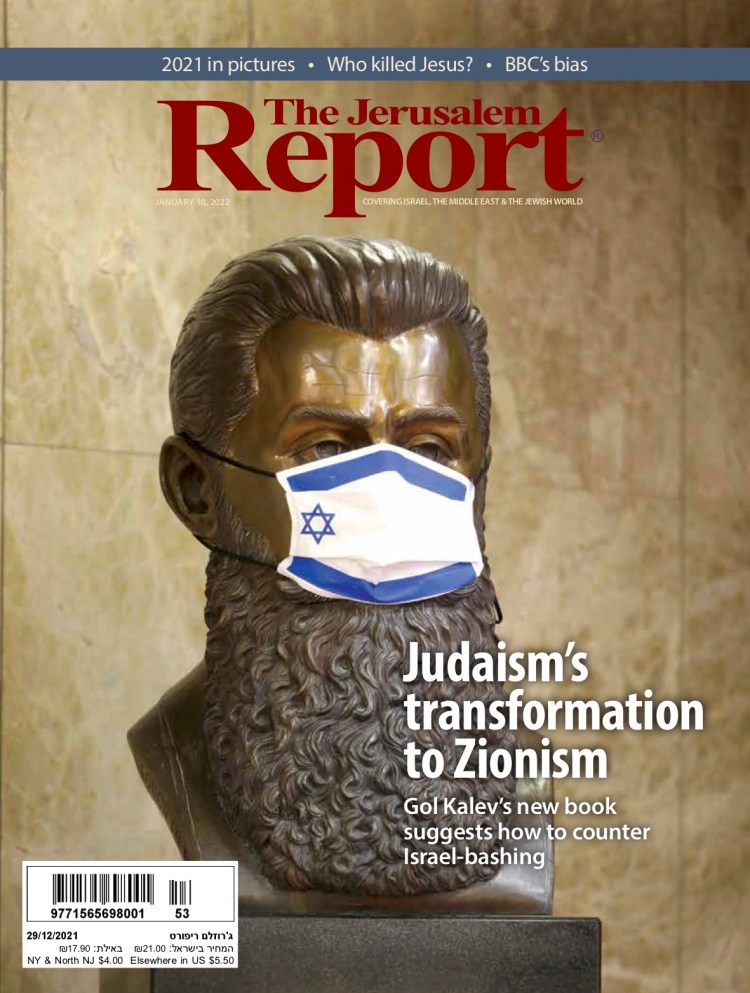
#1 Amazon Best-Seller in its category for New Releases, the book was chosen by the Jerusalem Report as the cover of its 2022 New Year Magazine even before published. In October 2022 the Jerusalem Post issued a Special Magazine about the book’s message

“Gol Kalev picks up where Herzl left off”
Fleur Hassan-Nahoum, Deputy Mayor of Jerusalem
Talking about Judaism 3.0:
Watch Gol Kalev apply the principles of Judaism 3.0 to his strategic analysis of the Gaza war: American Sunrise
Watch Gol Kalev discuss how Judaism 3.0 counters the threat of anti-Zionism (2022 Jerusalem Leaders Summit):
JUDAISM 3.0 ADDRESSES EXISTENTIAL THREATS TO JUDAISM:
Read summaries of the Jerusalem Post series showing how a broad recognition that we are in Judaism 3.0 could help counter the existential threat of Israel-bashing and anti-Zionsim:
Watch media coverage of the fifth Judaism 3.0 Begin Center event:

Watch Gol Kalev discuss Judaism 3.0 in an i24 interview with Emily Frances:
A revolutionary approach to countering Israel-bashing and anti-Zionism unveiled at the Judaism 3.0 book launch:
Watch video-clips, read a recap of the book launch party

Judaism 3.0 by Gol Kalev
Mazo Publishers
In this landmark book, Gol Kalev demonstrates how Zionism has turned into the organizing principle of Judaism. It has become the primary conduit through which both Jews and non-Jews relate to Judaism – in both the positive and negative.
Through an in-depth analysis of long-term shifts in Israel and in North American Jewry, as well as assessment of global trends that impact Judaism, Kalev shows that the anchor of the Jewish nation-religion has shifted from its religious aspect (Judaism 2.0) to its national aspect (Judaism 3.0).
Tying Theodor Herzl’s original vision of Zionism to today’s realities, Kalev shows that Judaism 3.0 is not only the most accurate reflection of the contemporary state of Judaism, but also the relevant framework to address emerging threats to Judaism. First and foremost, the existential threat of Israel-bashing, which has replaced anti-Semitism as the primary currency of age-old opposition to Judaism.
“Gol Kalev does not just know Theodor Herzl – he lives and breathes Theodor Herzl…This book should trigger the conversation the Jewish community needs about Israel, Zionism, Judaism and Identity. Bravo!”
Professor Gil Troy, author – The Zionist Ideas
ייA remarkable ideas book that is about much more than the state of Judaism…One of the most important books about Judaism, Zionism and global trends of our times.”
Catherine Carlton, former Mayor of Menlo Park, Silicon Valley tech entrepreneur
“This book should play an important role in the discussions about the future of world Jewry and its relations with Israel.”
Natan Sharansky, former Chairman of The Jewish Agency, former Deputy Prime Minister of Israel
“Gol Kalev’s book has the merit to transform the very essence of the State of Israel to becoming an objective expression of Jewish identity“
Dr. Georges Yitzhak Weisz, author – Theodor Herzl: A New Reading
“This book has sparked as much conversation as it has because the premise is so interesting, so counter-intuitive and demand of us that we think many thing anew. That is perhaps the greatest gift a book can give.”
Dr. Daniel Gordis, author – We Stand Divided
“Fresh new thinking about the relationship between Judaism and Israel. Kalev picks up where Herzl left off…A must read for people of all religious and political backgrounds who want to get a deeper understanding of the state of Zionism and Judaism today.”
Fleur Hassan-Nahoum, Deputy Mayor of Jerusalem
“A courageous thesis that must be part of any serious discussion of the future of Israel and the Jewish people.”
Michael Oren, historian, former ambassador of Israel to the United States
About the Author: Gol Kalev is a former Wall Street investment banker who has been researching Herzl and Zionism. Growing up in Tel Aviv and serving in the Israeli army, he then lived in New York and now resides in Jerusalem. He also spent time in various European cities and has traveled through both the American and European countryside, learning about contrasting world-views.

He is chairman of The AIFL Think Tank, which explores Zionism and Judaism, and has been writing analysis articles about Zionism, Europe, and global affairs for the Jerusalem Post, Jerusalem Report, Israel Hayom, The Daily Wire, The Media Line, Newsweek and Foreign Policy.
He has been praised for his unique understanding of Judaism by people throughout the political and religious spectrum. In this book, he delivers the state of Judaism as he sees it: Zionism as the anchor of Judaism.
For information about bulk purchases with a dedication page: Judaism 3.0 Holiday Gift
Sign-up to get updates on the book’s launch events:


For comments and inquiries: info@Judaism-Zionism.com

